SEO Results That Speak: Real Google Search Console Data 2026
See real Google Search Console data: 19.7K clicks, 103K impressions, and a 1.9 average position in 28 days. Learn the white hat SEO, AIO, and GEO approach behind it.: /seo-results-google-search-console-data-2026
Google Search Console SEO results , SEO expert in India, white hat SEO, technical SEO, GEO expert, AIO, organic traffic growth, search visibility
Introduction: Why Real Data Matters in SEO
Anyone can say they are an SEO expert. Far fewer can show how they measure results.
Rankings matter, but they are only one part of the picture. A keyword sitting at position one means little if nobody clicks, or if the people who click leave immediately. What tells the real story is measurable search visibility, organic clicks, and user engagement over time.
That is why I share my Google Search Console (GSC) performance data. It is first-party data straight from Google, and it shows how a website actually performs in search, not how a third-party tool estimates it. In this article, I walk through the key numbers from my recent performance, explain what each metric means, and describe the white hat, data-driven approach behind the results.
Key SEO Performance Highlights (Last 28 Days)
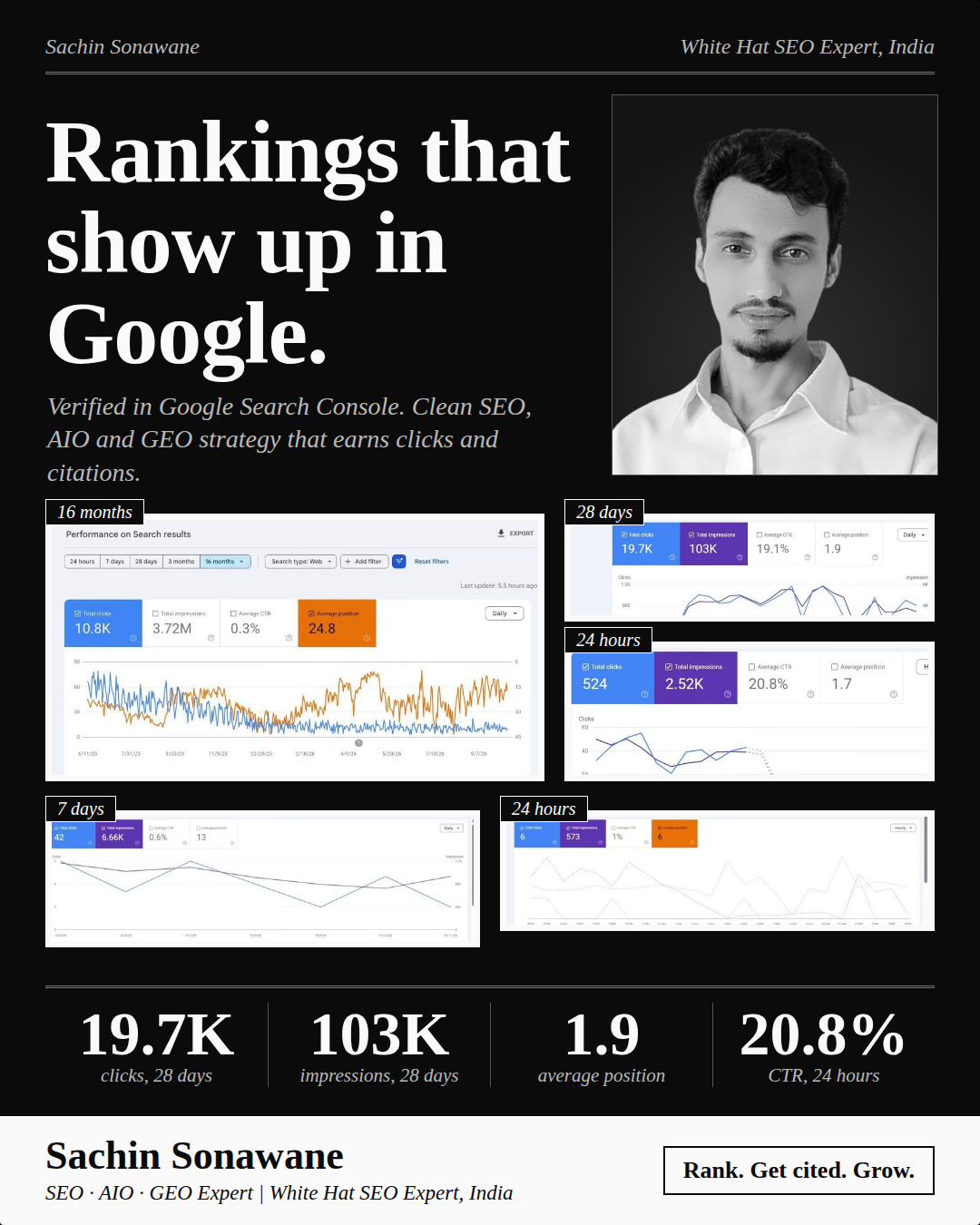
Here are the headline numbers from my Google Search Console data:
- ✅ 19.7K clicks in the last 28 days
- ✅ 103K impressions in the last 28 days
- ✅ 1.9 average position in the last 28 days
- ✅ 20.8% CTR in the last 24 hours
Let’s break down what each of these means and why it matters.
Clicks: Real People Visiting the Website
Clicks count how many times someone searched on Google and then clicked through to your site. This is the metric closest to actual traffic. 19.7K clicks in 28 days shows that the pages are not just appearing in search results but earning visits from real users.
Impressions: Your Search Visibility
An impression is counted when your page appears in a search result a user could see. 103K impressions shows how often the site is surfacing for relevant searches. Impressions are a leading indicator: when they rise, it usually means Google is testing your pages for more queries, which creates the opportunity for more clicks.
Average Position: Where You Appear
Average position shows the typical ranking of your pages across all the queries they appear for. An average position of 1.9 means that, on average, the site appears at or near the top of the results. This figure is an average across many queries, so individual keywords will vary, and it is most meaningful when read alongside clicks and CTR.
CTR: Are People Choosing Your Result?
16-Month Performance Tracking: Why the Long View Wins
A 28-day snapshot is useful, but SEO is a long game. Google Search Console lets you view up to 16 months of data, and that longer window is where the real insights are.
Long-term tracking helps you:
- Identify ranking trends. Are positions improving steadily, or did a recent update cause a dip?
- Spot traffic patterns. Seasonality, festivals, and industry cycles all leave a signature in the data.
- Find growth opportunities. Pages with high impressions but low CTR are prime candidates for better titles and descriptions.
- Detect problems early. A sudden drop in impressions can signal indexing issues, penalties, or technical errors.
- Prove the value of your work. Comparing 16 months of data lets you connect specific optimizations to measurable outcomes.
(Tip for your blog: add your 16-month GSC performance screenshot here with alt text such as “Google Search Console 16-month performance graph showing clicks and impressions growth 2026.”)
What Drives My SEO Approach?
Results like these do not come from a single trick. They come from a consistent system built on six pillars.
🔹 White Hat SEO: Sustainable Optimization
White hat SEO means following search engine guidelines: quality content, honest link building, a strong user experience, and technical excellence. It may feel slower than shortcuts, but it protects your site from penalties and builds growth that lasts. Shortcuts can work briefly and then collapse after an algorithm update. Ethical SEO compounds.
🔹 Technical SEO: A Foundation Search Engines Can Trust
Great content cannot rank if search engines cannot properly access it. Technical SEO covers:
- Crawlability: making sure search bots can reach your important pages
- Indexability: ensuring the right pages are indexed and the wrong ones are not
- Site architecture: a clear structure and internal linking that spreads authority
- Performance: fast loading, mobile-friendliness, and healthy Core Web Vitals
- Structured data: schema markup that helps search engines understand your content
Google Search Console is invaluable here, with its indexing reports, Core Web Vitals reports, and crawl data pointing straight to what needs fixing.
🔹 Content Optimization: Intent and Relevance
Good content starts with understanding search intent. Is the person trying to learn, compare, or buy? Content that matches intent, covers a topic thoroughly, and answers the real question tends to earn both rankings and clicks. Optimization includes:
- Targeting the right primary and supporting keywords naturally
- Writing clear headings and scannable sections
- Updating older pages with fresh information
- Building topical relevance by covering a subject in depth across connected pages
🔹 AIO & GEO: Adapting to AI-Powered Discovery
- AIO (AI Optimization) means preparing structured, clean, well-organized content that AI systems can easily read and repurpose.
- GEO (Generative Engine Optimization) focuses on improving the chances that your brand and content are cited in AI-generated answers.
In practice, this means clear entities, original insights, strong topical authority, semantic HTML, consistent formatting, and schema markup. The same quality signals that help you rank in classic search also help you get cited by AI, so the two strategies reinforce each other.
🔹 Data-Driven Decisions: Let Google’s Data Guide You
Every decision is backed by data. I use Google Search Console to monitor:
- Clicks: actual traffic from search
- Impressions: visibility and reach
- CTR: how compelling your listings are
- Average position: ranking strength
Instead of guessing, I look for patterns: which queries are rising, which pages are slipping, and where a small change could bring a large gain.
🔹 Continuous Improvement: SEO Is Never Finished
Search algorithms, user behavior, and competitors all keep changing. The best approach is a loop: measure, analyze, improve, and measure again. Refining strategy based on evidence, not assumptions, is what keeps performance steady over time.
How to Read Your Own Google Search Console Data
If you want to track your SEO the same way, here is a simple process:
- Open the Performance report and compare date ranges (for example, last 28 days versus the previous period).
- Turn on all four metrics: clicks, impressions, CTR, and average position.
- Check the Queries tab to see which searches bring visibility and clicks.
- Check the Pages tab to find your top performers and your underperformers.
- Look for high-impression, low-CTR pages. Improve their titles and meta descriptions.
- Look for queries in positions 4 to 15. These are often the easiest opportunities to move higher with better content or internal links.
- Review the Indexing and Core Web Vitals reports for technical issues.
- Extend the date range to 16 months to see the bigger trend before making big decisions.
Common Mistakes When Measuring SEO
- Only watching rankings. Rankings without clicks or conversions do not grow a business.
- Judging results from a single day. Daily numbers fluctuate. Use them as signals, then confirm with longer ranges.
- Ignoring impressions. A drop in impressions often shows up before a drop in traffic.
- Chasing keywords instead of intent. Matching what users actually want matters more than keyword counts.
- Neglecting technical health. Slow pages and indexing errors quietly limit everything else.
- Treating SEO as a one-time project. It is ongoing work.
My SEO Philosophy: Rank. Get Cited. Grow.
Modern SEO is not just about chasing keywords or publishing more content. It is about:
- Understanding search behaviour: knowing what people look for and why
- Building relevant content: useful pages that deserve to rank
- Improving technical foundations: a site that search engines and AI tools can read easily
- Measuring outcomes that matter: clicks, leads, and conversions, not vanity numbers
Rank in traditional search. Get cited in AI-driven search. Grow a sustainable digital presence. That is the focus, and it is built on evidence rather than promises.
A note on expectations: SEO results depend on your industry, competition, website condition, and consistency. The numbers in this article reflect my own Search Console data, and every business will see a different path. No honest SEO professional can guarantee specific rankings, but a transparent, data-led process gives you the best chance of steady progress.
Frequently Asked Questions
1. What is Google Search Console?
Google Search Console is a free tool from Google that shows how your website performs in search, including clicks, impressions, average position, indexing status, and technical issues.
2. What is a good average position in Google Search Console?
Lower is better. An average position near 1 to 3 means your pages typically appear at the top of results. Remember that it is an average across many queries, so check individual keywords too.
3. What is a good CTR for SEO?
It depends heavily on position, search intent, and whether queries are branded. Top positions generally earn much higher CTR than lower ones. Compare your CTR against your own history and similar queries rather than a single universal number.
4. What is the difference between clicks and impressions?
Impressions count how often your page appeared in search results. Clicks count how often users actually visited. Clicks divided by impressions gives your CTR.
5. What is the difference between SEO, AIO, and GEO?
SEO improves rankings in traditional search. AIO prepares content so AI tools can easily read and reuse it. GEO aims to get your brand cited in AI-generated answers. Together they cover both classic and AI-powered discovery.
6. Why does the 16-month view matter?
It reveals long-term trends, seasonality, and the effect of past optimizations that shorter windows cannot show.
7. How long does SEO take to work?
It varies by competition and site condition. Many sites see early movement within a few months, with stronger results building over time through consistent work.
Conclusion: Let the Data Tell the Story
Rankings are important, but they are only the beginning. Real growth shows up in clicks, impressions, CTR, and average position, and in how those numbers move over months, not days. By combining white hat SEO, technical SEO, content optimization, AIO, GEO, and data-driven decisions, you build visibility that holds up across both traditional search and emerging AI-driven experiences.
If you want a clear picture of where your website stands, start with your own Google Search Console data. The answers are usually already there.
💬 What matters most to your business: rankings, qualified organic traffic, leads, or conversions? Tell me, and let’s build a plan around it.
— Sachin Sonawane
SEO | AIO | GEO Expert | White Hat SEO Expert, India